 Remember it’s all about efficiency:
- Resources: data + hardware (compute, memory, communication bandwidth)
- How do you train the best model given a fixed set of resources?
Today, we are compute-constrained, so design decisions will reflect squeezing the most out of given hardware.
- Systems: clearly about efficiency
- Tokenization: working with raw bytes is elegant, but compute-inefficient with today’s model architectures
- Model architecture: many changes motivated by reducing memory or FLOPs (e.g., sharing KV caches, sliding window attention)
- Data filtering: avoid wasting precious compute updating on bad / irrelevant data
- Scaling laws: use less compute on smaller models to do hyperparameter tuning
Tokenization
a tokenizer converts between raw inputs (bytes) and sequences of integers (tokens)
 Popular tokenizer: Byte-Pair Encoding (BPE)
- [Sennrich+ 2015] Intuition: break input into frequently-occuring chunks
Efficiency lens
- Reduce context length (1000 bytes → ~250 tokens)
- Adaptive computation (more modeling capacity on interesting parts of input) The dream: tokenizer-free model architectures, which operate directly on bytes
- [Xue+ 2021]
- [Yu+ 2023]
- [Pagnoni+ 2024]
- [Deiseroth+ 2024]
- [Hwang+ 2025] These are promising, but have not yet been scaled up to the frontier.
Model architecture
Starting point: original Transformer
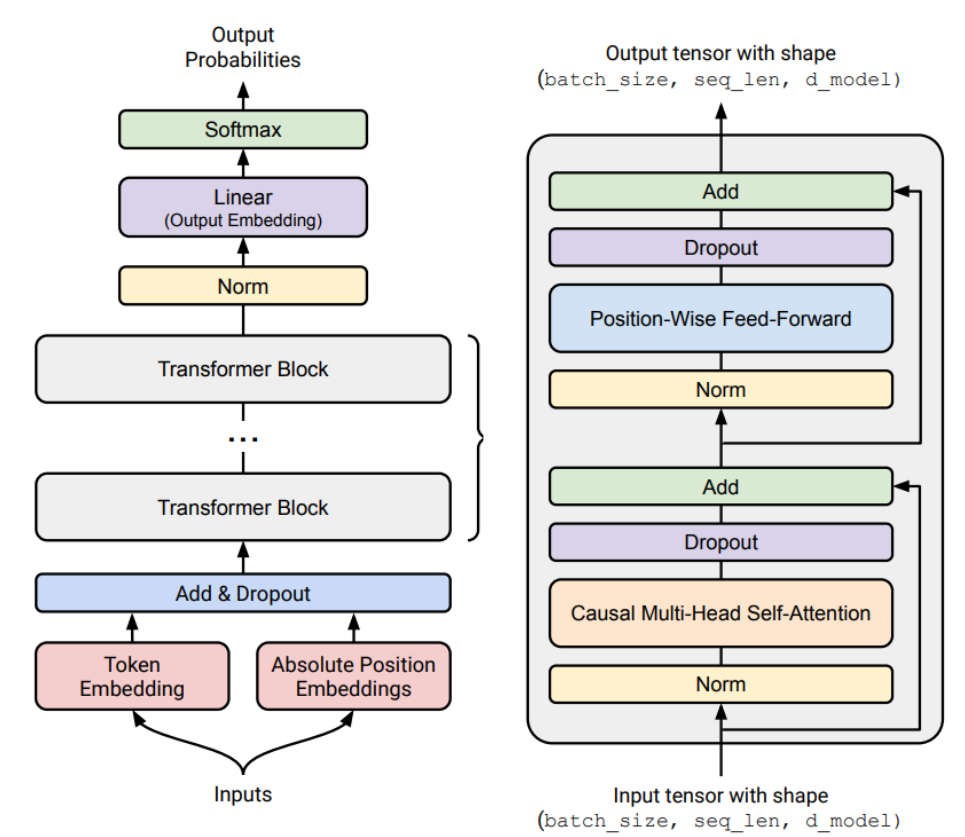
Refinements:
-
Activation functions: ReLU, SwiGLU
-
Positional encodings: sinusoidal, RoPE
-
Normalization: LayerNorm, RMSNorm, QK norm, pre-norm versus post-norm
-
Attention: full, sparse/local attention, group-query attention (GQA), multi-head latent attention (MLA)
-
Recurrence/state-space models/linear attention: Mamba, Gated DeltaNet
-
MLP: dense, mixture of experts
-
Shape (hidden dimension, depth, number of heads, number of experts)